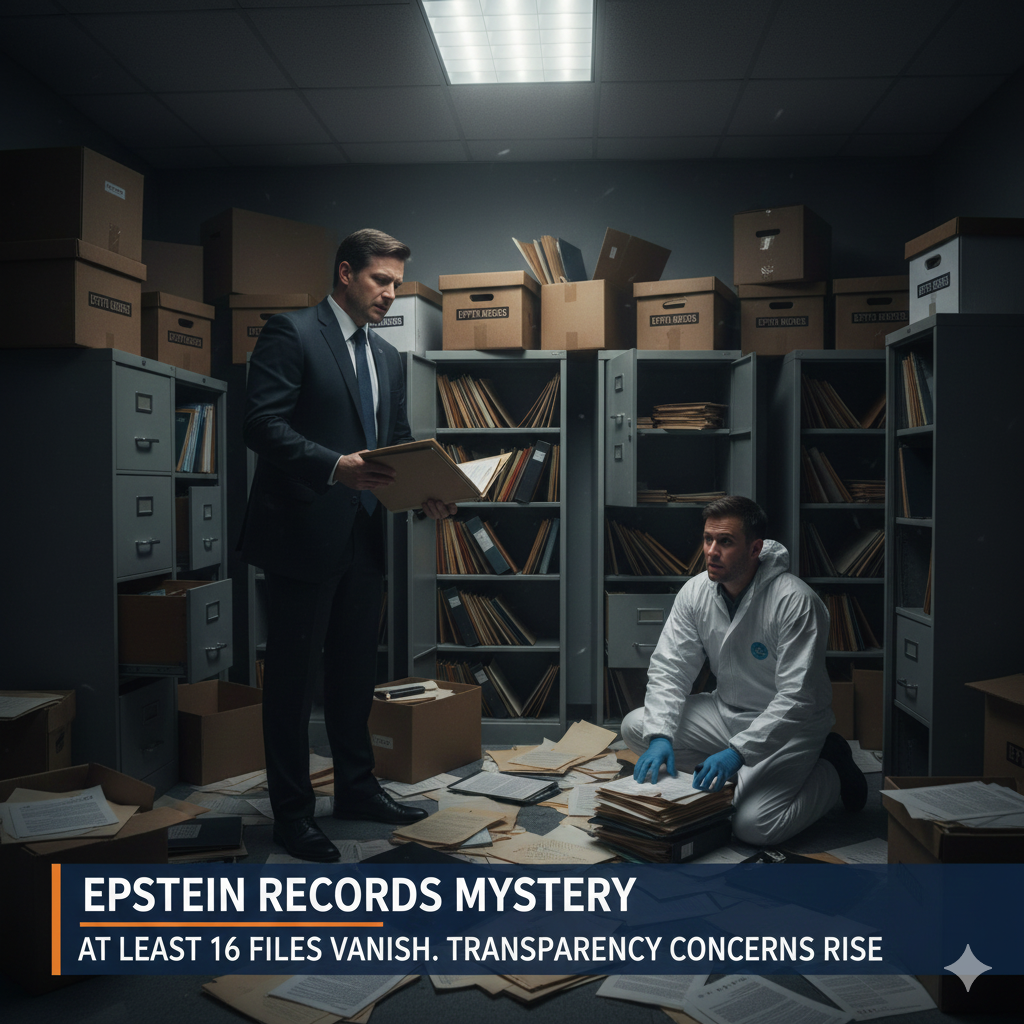
The unexplained disappearance of at least 16 files from the U.S. Justice Department’s public webpage dedicated to records related to Jeffrey Epstein has intensified scrutiny over the government’s long-awaited document release and renewed questions about transparency in one of the most controversial criminal cases in recent American history.
The files, which were publicly accessible on Friday, were no longer available by Saturday—less than 24 hours later. The Justice Department has not offered an explanation for their removal, nor did it notify the public that any materials had been taken down. Among the missing items was an image that included a photograph of U.S. President Donald Trump alongside Epstein, Melania Trump, and Epstein’s longtime associate, Ghislaine Maxwell.
Missing Files Spark Questions and Speculation
The vanished documents included a range of images, some depicting paintings of nude women inside Epstein’s properties and others showing collections of photographs stored along a credenza and inside drawers. One such image showed multiple photographs arranged together, including the photo featuring Trump and Epstein with Melania Trump and Maxwell.
The sudden disappearance of these files, without explanation, quickly fuelled speculation online about what had been removed and why. The lack of transparency has only deepened public suspicion surrounding Epstein’s powerful social network and the handling of records related to his crimes.
The Justice Department declined to comment on the removals. A spokesperson did not immediately respond to requests seeking clarification on whether the files were removed intentionally, temporarily, or due to an administrative error.
Political Reaction and Calls for Accountability
Democrats on the House Oversight Committee publicly highlighted the missing image featuring Trump in a post on X, writing, “What else is being covered up? We need transparency for the American public.” The comment echoed broader concerns among lawmakers and advocacy groups that the document release has fallen short of its promise to provide clarity and accountability.
A Highly Anticipated Release With Limited New Information
The missing files controversy comes amid growing disappointment over the Justice Department’s broader release of Epstein-related records. Tens of thousands of pages were made public following the passage of a new law requiring disclosure, but the documents have so far offered limited new insight into Epstein’s crimes or the prosecutorial decisions that allowed him to avoid serious federal charges for years.
Many of the most closely watched materials were absent from the initial release, including FBI interviews with victims and internal Justice Department memoranda analyzing charging decisions. These records were expected to shed light on how investigators evaluated the case and why Epstein was allowed in 2008 to plead guilty to a relatively minor state-level prostitution charge.
Gaps in the Record Continue to Raise Questions
The omissions go beyond individual files. Several prominent figures long associated with Epstein—including Britain’s former Prince Andrew—are barely referenced in the released documents, reigniting questions about who was scrutinized, who was not, and how comprehensive the disclosures truly are.
While the records did include some new details, critics say they do little to advance public understanding of how Epstein operated for so long without facing meaningful consequences.
Images, Celebrities, and Limited Context
Much of the material released so far consists of photographs from Epstein’s homes in New York City and the U.S. Virgin Islands, along with images showing Epstein in the company of celebrities and political figures.
Among the newly released photos were a series of previously unseen images of former U.S. president Bill Clinton. There were far fewer images of Trump, though both men have acknowledged knowing Epstein in the past while later distancing themselves from him. Neither Clinton nor Trump has been accused of wrongdoing in connection with Epstein, and there is no indication that the photographs played any role in criminal cases against him.
Other images showed Epstein alongside well-known figures such as Michael Jackson, Diana Ross, Chris Tucker, Kevin Spacey, and veteran broadcaster Walter Cronkite. However, the photos were largely presented without captions or context, leaving unanswered questions about when, where, or why the individuals were together.
Trump’s Republican allies were quick to focus on images featuring Clinton, while Democrats pointed to the missing Trump-related photo, underscoring how the document release has become entangled in partisan debate.
Rolling Releases and Growing Frustration
Despite a congressional deadline requiring the Justice Department to make the records public by Friday, officials said the documents would be released on a rolling basis. The department cited the time-consuming process of redacting survivors’ names and other identifying details as the reason for the delay.
However, the lack of a clear timeline for future releases has angered some members of Congress and Epstein’s accusers, many of whom fought for years to force disclosure.
Instead of marking the end of a prolonged battle for transparency, the initial release has become the beginning of what appears to be an open-ended wait for a complete accounting of Epstein’s crimes and the government’s response to them.
“I feel like again the DOJ, the justice system is failing us,” said Marina Lacerda, who alleges Epstein began sexually abusing her when she was 14 at his New York City mansion.
Redactions and Missing Context Limit Impact
Many of the documents released so far were heavily redacted or lacked sufficient context to be fully understood. Some had already been made public through court filings, congressional investigations, or freedom-of-information requests, but were now consolidated into a single, searchable database for the first time.
Others, though new to the public, were nearly impossible to interpret. One 119-page document labelled “Grand Jury-NY,” believed to relate to federal sex trafficking investigations that led to charges against Epstein in 2019 or Maxwell in 2021, was entirely blacked out.
According to Deputy Attorney General Todd Blanche, Manhattan federal prosecutors alone possessed more than 3.6 million records from sex trafficking investigations involving Epstein and Maxwell, many of which duplicated FBI material. The documents released so far represent only a fraction of what exists.
Evidence of a Strong Case That Went Nowhere
Among the most significant revelations in the released materials are indications that federal prosecutors had what appeared to be a strong case against Epstein as early as 2007, yet declined to pursue charges.
For the first time, transcripts of grand jury proceedings were made public, including testimony from FBI agents who described interviews with girls and young women who said they were paid to perform sex acts for Epstein. The youngest victim mentioned was 14 years old and in Grade 9.
One witness told investigators she was sexually assaulted by Epstein after initially resisting his advances during a massage. Another, who testified before the grand jury at age 21, described how Epstein hired her at 16 and later encouraged her to recruit other girls.
“For every girl that I brought to the table he would give me US$200,” she said, adding that she told underage girls to lie about their age.
Decisions That Continue to Haunt the Justice System
The documents also include a transcript of a later interview conducted by Justice Department lawyers with Alexander Acosta, the U.S. attorney who oversaw the case in the 2000s and later served as labour secretary during Trump’s first term.
Acosta cited concerns about whether a jury would believe Epstein’s accusers and said prosecutors struggled with how to classify the case, which straddled the line between sex trafficking and prostitution—an area often handled by state authorities.
“I’m not saying it was the right view,” Acosta said, acknowledging that public attitudes toward victims have since changed. “There’s been a lot of changes in victim shaming.”
Conclusion: Transparency Still Elusive
The unexplained removal of files from the Epstein document release has only compounded longstanding doubts about how thoroughly the federal government is confronting its past handling of the case. While the disclosures have provided glimpses into prosecutorial failures and disturbing victim testimony, major gaps remain.
For survivors, lawmakers, and the public, the promise of full transparency remains unfulfilled. Until all records are released—and explained—the Epstein case will continue to stand as a symbol of unanswered questions, institutional failure, and the enduring struggle for accountability.