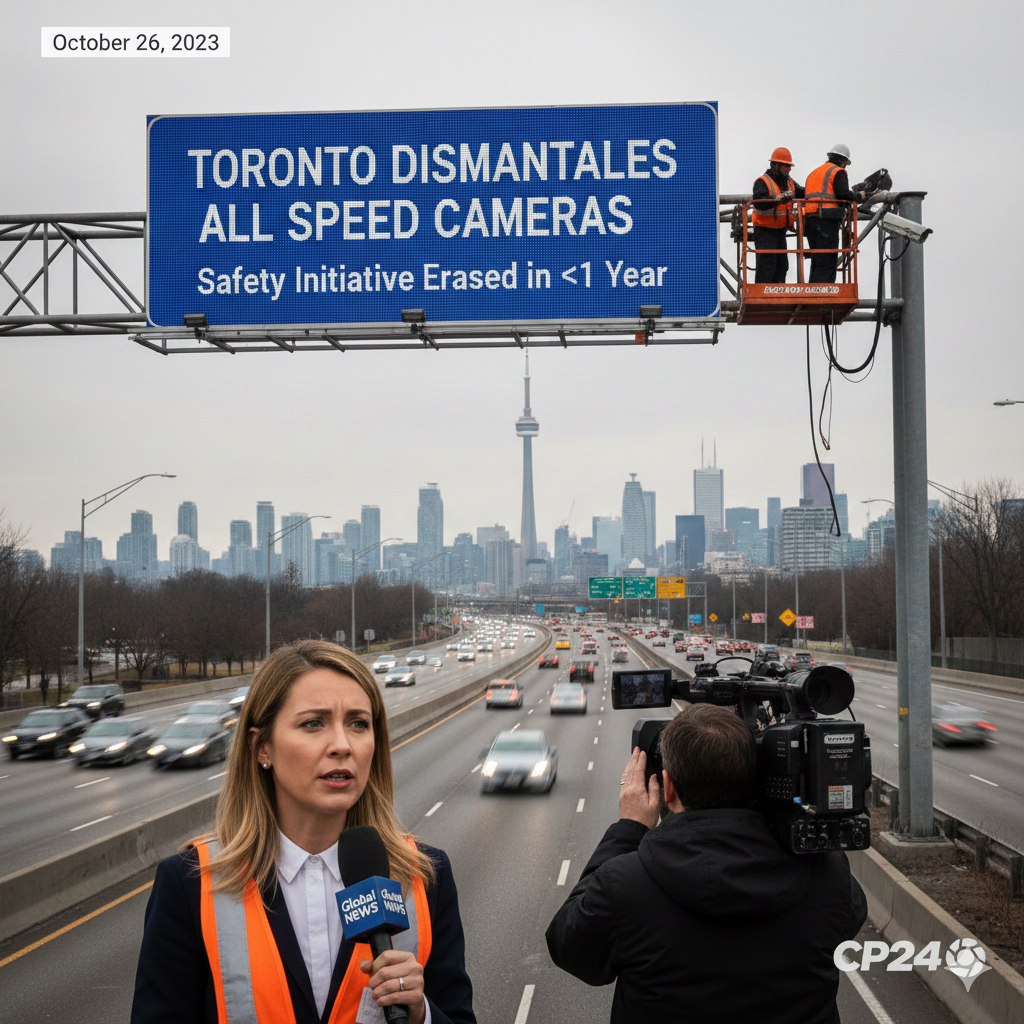
In an unprecedented reversal of a major road safety policy, every automated speed enforcement camera in Toronto has now been removed. Once a central piece of the city’s strategy to curb dangerous driving and protect pedestrians, the cameras were dismantled by the very vendor that installed them, bringing a turbulent chapter in municipal road safety to a close.
The sudden disappearance of the devices is not the result of vandalism, technical failures, or city-led budget cuts. Instead, it is the endpoint of a politically charged campaign led by Ontario Premier Doug Ford, who repeatedly referred to the devices as a revenue-generating “cash grab” rather than a life-saving safety measure. In less than twelve months, Toronto went from expanding its automated enforcement program to eliminating it entirely.
This is the story of how that happened — and what it means for the future of road safety in Ontario’s largest city.
A Tragedy That Prompted Change
The push toward automated speed enforcement was rooted in a devastating and avoidable tragedy. In the fall of 2021, Valdemar Avila, 71, and his wife, Fatima Avila, 69, were sitting in slow-moving rush-hour traffic on Parkside Drive, a busy roadway bordering High Park. Although the speed limit was clearly marked at 50 kilometres per hour, a BMW driven by 38-year-old Artur Kotula struck their Toyota from behind at more than twice the permitted speed.
The impact was catastrophic. Valdemar died at the scene. His wife, who had immigrated to Canada with him in the 1970s, later died in hospital from her injuries. The incident sent shockwaves through the community and across the city.
In the aftermath, Toronto lowered the speed limit on Parkside Drive to 40 km/h and installed a speed camera in an effort to prevent similar tragedies. The results were immediate and striking. Between April 2022 and March 2023, the camera alone issued 24,556 speeding tickets.
Kotula was eventually sentenced to six-and-a-half years in prison. The presiding judge described his behaviour as a “crime of stupidity,” underscoring the needless nature of the loss.
The Rise — and Target — of Toronto’s Speed Cameras
At first, speed cameras were seen by municipal officials and safety advocates as a logical and effective response to the city’s persistent speeding problem. By using automated technology to monitor speed in school zones and high-risk corridors, the city was attempting to change driver behavior without relying solely on police officers.
Rather than reducing the program, Toronto moved to expand it. After initial deployment of 75 cameras across the city, officials announced plans to double the number to 150. The logic was simple: fewer speeding vehicles would lead to safer streets, and ideally, fewer tickets would eventually be issued.
“If these cameras generated no revenue at all, that would mean the program was working,” said Barbara Gray, then-general manager of the city’s transportation division.
But not everyone saw the cameras as a safety tool. Increasingly, frustration and anger from certain drivers began to build, particularly in areas where repeat fines were common. Parkside Drive, the very site of the 2021 fatal collision, became a focal point of protest.
Repeated Vandalism Signals Growing Anger
By December 2024, the first act of direct defiance occurred. The Parkside Drive camera was cut down, dragged through mud, and dumped into High Park’s duck pond. It was a dramatic and symbolic rejection of the city’s efforts to slow drivers down.
That single act set off a wave of vandalism. Throughout 2025, speed cameras across Toronto were repeatedly targeted. Some were cut, others destroyed, and many had to be repaired or replaced. By early September, in one coordinated overnight spree, 16 cameras were taken down in multiple neighbourhoods across the city.
The destruction pointed to a deeper divide: while safety advocates praised the program, a vocal group of opponents viewed the cameras as unfair, invasive, and focused on profit rather than public welfare.
Premier Ford Enters the Battle
The very next day after the mass destruction of cameras in September, Premier Doug Ford publicly weighed in. His remarks left little doubt about where he stood.
“Hopefully the cities will get rid of them,” he said. “Or I’m going to help them get rid of them very shortly.”
From that moment, the fate of Toronto’s speed cameras was effectively sealed.
Ford doubled down on his position in the weeks that followed, arguing that physical traffic-calming infrastructure, such as speed bumps and signage, was more effective than automated ticketing systems. However, road safety experts were quick to push back against this argument.
“You cannot put speed bumps on major arterial roads,” said Linda Rothman, a researcher involved in urban transportation studies. “In the exact places where speeding is most dangerous, speed cameras are one of the few viable tools available.”
Despite these concerns, the province moved forward.
What the Research Really Showed
In the midst of the political debate, a powerful piece of evidence emerged in support of the cameras. A study conducted by researchers from the Hospital for Sick Children (SickKids) and Toronto Metropolitan University examined 250 school zones with speed cameras between July 2020 and December 2022.
The findings were clear and compelling.
“We observed a significant reduction in vehicle speeds,” said Dr. Andrew Howard, head of orthopedic surgery at SickKids and the study’s lead author. “What was especially encouraging was that the fastest drivers showed the greatest decrease in speed.”
In simple terms, the cameras were doing exactly what they were designed to do: slow cars down in places where children and pedestrians are most vulnerable.
Ontario’s police chiefs supported the findings, releasing a statement highlighting the effectiveness of Automated Speed Enforcement (ASE) tools in changing driver behavior and improving safety for all road users.
Still, the political momentum against the program continued to grow.
An Attempt to Compromise Falls Flat
Toronto Mayor Olivia Chow made several efforts to find middle ground with the provincial government. She proposed softer measures, including a grace period between the issuance of a first and second ticket. Her goal was to reduce the perception of the program as punitive while maintaining its safety benefits.
Additionally, mayors from other major Ontario cities joined together, writing a letter to Premier Ford in October. They warned that eliminating speed cameras would undocut years of progress in school zone safety and expose pedestrians, cyclists, and children to increased risks.
None of these efforts changed the outcome.
On October 20, the province introduced Bill 56 — formal legislation to end automated speed enforcement programs across Ontario.
With that, the decision was no longer in Toronto’s hands.
The Final Uninstall
By the end of November, every speed camera in the city had been removed. The process was carried out by Verra Mobility, the Arizona-based company that had supplied and maintained the equipment for Toronto.
In a statement, Verra Mobility confirmed it would be exiting the Ontario market altogether. While acknowledging the legislative decision, the company stood by the effectiveness of its technology.
“Speed cameras have a proven track record of improving road safety and reducing serious collisions,” the statement read.
Unlike past disappearances sparked by midnight sabotage, this time the process was orderly, official, and final. The cameras are gone — and there are currently no plans for their return.
What Happens Next for Road Safety in Toronto?
With automated enforcement off the table, the province has committed $210 million to municipalities for alternative traffic-calming strategies. These include speed bumps, increased signage, road narrowing, and other physical measures designed to slow cars down.
However, many urban planners and safety experts remain skeptical that these steps alone can replace the continuous, data-driven enforcement provided by cameras, particularly on busy city roads where physical modifications may be impractical or ineffective.
Residents, too, remain divided. Some have welcomed the decision, seeing it as a win for drivers. Others worry that, without constant monitoring, speeding may once again become the norm — and that more lives could be placed at risk.
Conclusion: A City at a Crossroads
Toronto’s experience with speed cameras is more than a story about traffic tickets. It is a reflection of how public safety, politics, public opinion, and evidence can collide — and sometimes override one another.
What began as a response to tragedy evolved into one of the city’s most ambitious safety programs, backed by research and supported by medical and law enforcement communities. Yet, in less than a year, it was undone by political will and growing public resistance.
Whether Toronto’s streets will become more dangerous or simply different in design remains to be seen. But one thing is certain: the debate over how best to keep roads safe in a growing urban environment is far from over.