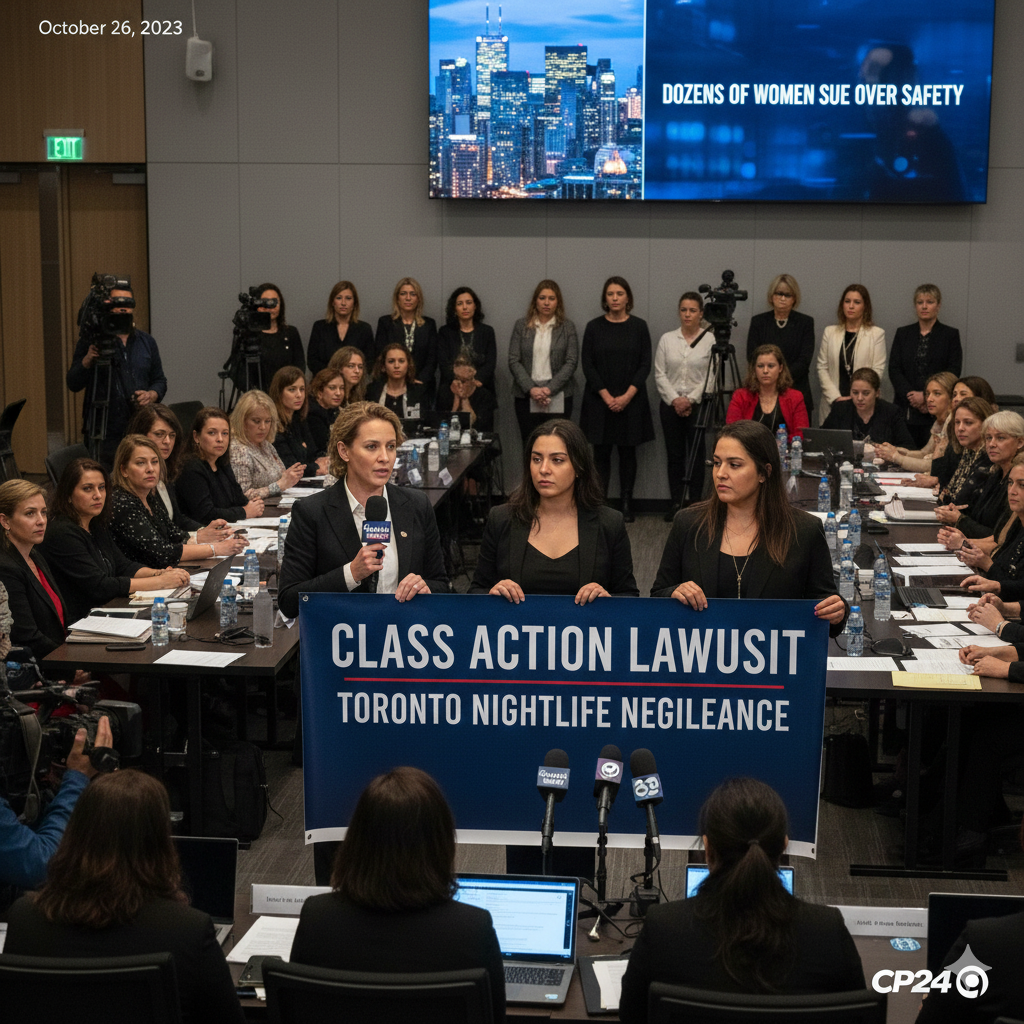
A growing group of women is preparing to launch a proposed class action lawsuit against a Toronto club promoter and several prominent nightlife companies, alleging systemic negligence that, they say, allowed decades of sexual violence to occur inside some of the city’s most popular venues. The legal action is being coordinated by End Violence Everywhere (EVE), a Canadian advocacy organization supporting survivors of abuse.
At the centre of the lawsuit is Mark Holland, a well-known Toronto club promoter who was convicted of sexual assault in 2020 and ordered to remain on the sex offender registry for 20 years. The proposed lawsuit also names multiple hospitality companies that allegedly continued to employ or work with Holland despite what EVE describes as knowledge — or at least reasonable awareness — of his past misconduct.
While no formal claim has yet been filed and the allegations have not been tested in court, EVE says dozens of women have now come forward with similar accounts of harm, identifying what they describe as a long-standing pattern of abuse enabled by the city’s nightlife ecosystem.
The unfolding situation has once again raised serious questions about accountability, corporate responsibility, and safety within Toronto’s bar and nightclub scene.
Advocacy Group Moves Forward With Proposed Legal Action
End Violence Everywhere (EVE) announced its intention to pursue a class action lawsuit against Holland and several hospitality companies believed to have employed him or provided him access to their venues over the years. According to a draft of the proposed lawsuit reviewed by CBC News, the companies named include Honeycomb Hospitality, Lobby, INK Entertainment, and Uniq Hospitality.
The draft alleges that the companies worked with Holland “despite knowledge or constructive knowledge of his past misconduct,” and failed to take reasonable measures to protect patrons from harm.
“Over the span of nearly two decades, numerous women have reported being sexually assaulted, drugged, or otherwise harmed by Mark Holland,” the draft states. “These incidents followed a consistent pattern, often beginning in VIP areas or at private after-parties and ending in secluded areas of the venues or affiliated residences.”
EVE founder Cait Alexander announced that the organization is currently representing approximately 30 women with direct allegations involving Holland. In addition, more than 20 others have shared experiences involving different individuals whom EVE claims were also permitted to operate within the same nightlife spaces despite known risks.
Deadline Issued to Companies Named in the Draft
Alexander said that the proposed legal action can still be prevented if the companies involved meet specific conditions by December 1. These include issuing a public apology, acknowledging responsibility, and signing a formal agreement with EVE outlining changes to ensure safety for women within their establishments.
“For too long, survivors have been silenced, ignored, or pushed aside while profits came first,” Alexander said during a news conference. “These companies cannot claim innocence when they were warned, informed, or otherwise made aware of the danger they were hosting inside their own spaces.”
So far, Honeycomb Hospitality has stated that it has “no comment at this time.” The other named companies had not provided public responses as of the latest update.
Allegations Point to a Pattern of Abuse Spanning Decades
According to EVE, the reported incidents date back as far as the late 1990s and stretch into 2025. After Holland’s most recent criminal charges in August 2025 — which reportedly included three counts of sexual assault and one count of disobeying a court order — Alexander posted a warning on social media. The response, she says, was overwhelming.
She received thousands of messages from individuals describing their experiences in Toronto’s nightlife scene. From this, EVE compiled a detailed list of more than 50 potential victims, several alleged perpetrators, and numerous industry insiders who were allegedly aware of what was happening but failed to intervene.
Despite these serious allegations, Holland was reportedly able to continue working in nightlife settings after being released on bail. His defence lawyer, Randall Barrs, has stated that Holland’s bail conditions did not restrict where he could work.
Barrs acknowledged that there have been multiple accusations against his client in the past but emphasized that Holland was acquitted of several historic charges.
Legal Background and Prior Convictions
Holland’s legal history includes a mixture of convictions, acquittals, and dismissed charges. In 2016, he was charged in connection with an alleged sexual assault involving an 18-year-old woman at a photoshoot. He was later acquitted of that charge.
Following that investigation, Toronto police received information suggesting there may be additional victims. This led to four more charges related to incidents that allegedly occurred between 1994 and 2014. Of these, one resulted in a 2020 conviction involving an assault in a nightclub stairwell in 2008.
After delays caused by the COVID-19 pandemic, Holland was sentenced in 2022. The court ordered him to remain on the sex offender registry for 20 years and imposed eight months of conditional imprisonment, including house arrest.
Two other allegations were dismissed in court, and a fourth was downgraded to a common assault charge, which was resolved through a peace bond agreement. Barrs has pointed to this mixed legal outcome as evidence that further judgment should be reserved for the courts.
“In this country, we have a presumption of innocence,” Barrs said in a written statement. “Mr. Holland has one conviction. The rest have been acquitted. These public attacks have cost him his livelihood and compromised his ability to receive a fair trial.”
Survivors Share Emotional Testimonies
At EVE’s recent news conference, two women publicly shared their experiences for the first time. Although they did not reveal their identities, they described the profound emotional and psychological impact that has stayed with them for years.
One woman said she was assaulted by Holland during a 2016 modelling photoshoot. Although the case ended in an acquittal, she explained that learning about his more recent charges caused old trauma to resurface.
“I am devastated to know that he is still out there, and even more devastated that people continue to enable him,” she said. “Why are men like this protected more than the women they harm?”
Another woman spoke about an alleged assault that took place nearly 18 years ago. She reported the incident to police in 2016, but the case did not result in a conviction. After returning to Toronto in 2025, she was shocked to learn that Holland was allegedly still working in the same industry.
“Imagine knowing that despite decades of allegations, trials, and even a conviction, he was still being welcomed into these spaces,” she said. “That is not just one person failing — that is a system failing.”
Demands for Industry-Wide Reform
Beyond monetary damages, the proposed class action lawsuit seeks legal commitments to reform safety policies within Toronto’s nightlife industry. EVE is demanding that companies ban convicted sexual offenders from working or collaborating with their venues and implement stronger protective measures for patrons.
Lawyer Kathryn Marshall, who is representing EVE in the proposed lawsuit, described the situation as a wake-up call for the entire hospitality sector.
“These businesses turned their clubs into hunting grounds by ignoring clear warning signs,” Marshall said. “Profit was prioritized over people. This case must become the catalyst for systemic change.”
Marshall added that the required reforms are not just about one individual, but about addressing a deeply embedded culture of silence and negligence.
A Broader Conversation on Safety and Accountability
The proposed lawsuit arrives at a critical moment, as Toronto and other Canadian cities confront rising concerns around gender-based and intimate partner violence. Authorities and advocacy groups have repeatedly warned that more must be done to protect women in public and private spaces.
While the final outcome of the proposed legal action remains uncertain, one outcome is already clear: more women are stepping forward, more stories are being heard, and longstanding structures that once allowed silence are now being challenged.
For survivors, this moment represents more than just legal action — it represents a chance for recognition, accountability, and transformation.
Conclusion: A Turning Point for Toronto’s Nightlife Industry
Although the class action lawsuit has not yet been formally filed, its impact is already being felt throughout Toronto’s nightlife community. Allegations of negligence against powerful hospitality companies have sparked debate, raised public awareness, and intensified demands for reform.
If the case proceeds, it could become one of the most significant legal challenges ever faced by the city’s entertainment industry. Even if it is resolved outside of court, it has already opened a critical conversation about responsibility, trust, and the duty of care owed to every person who walks through a club or restaurant door.
For the dozens of women preparing to take legal action, the goal is clear: ensuring that no one else has to endure what they experienced, and that the spaces meant for enjoyment and celebration are never again allowed to become places of fear.