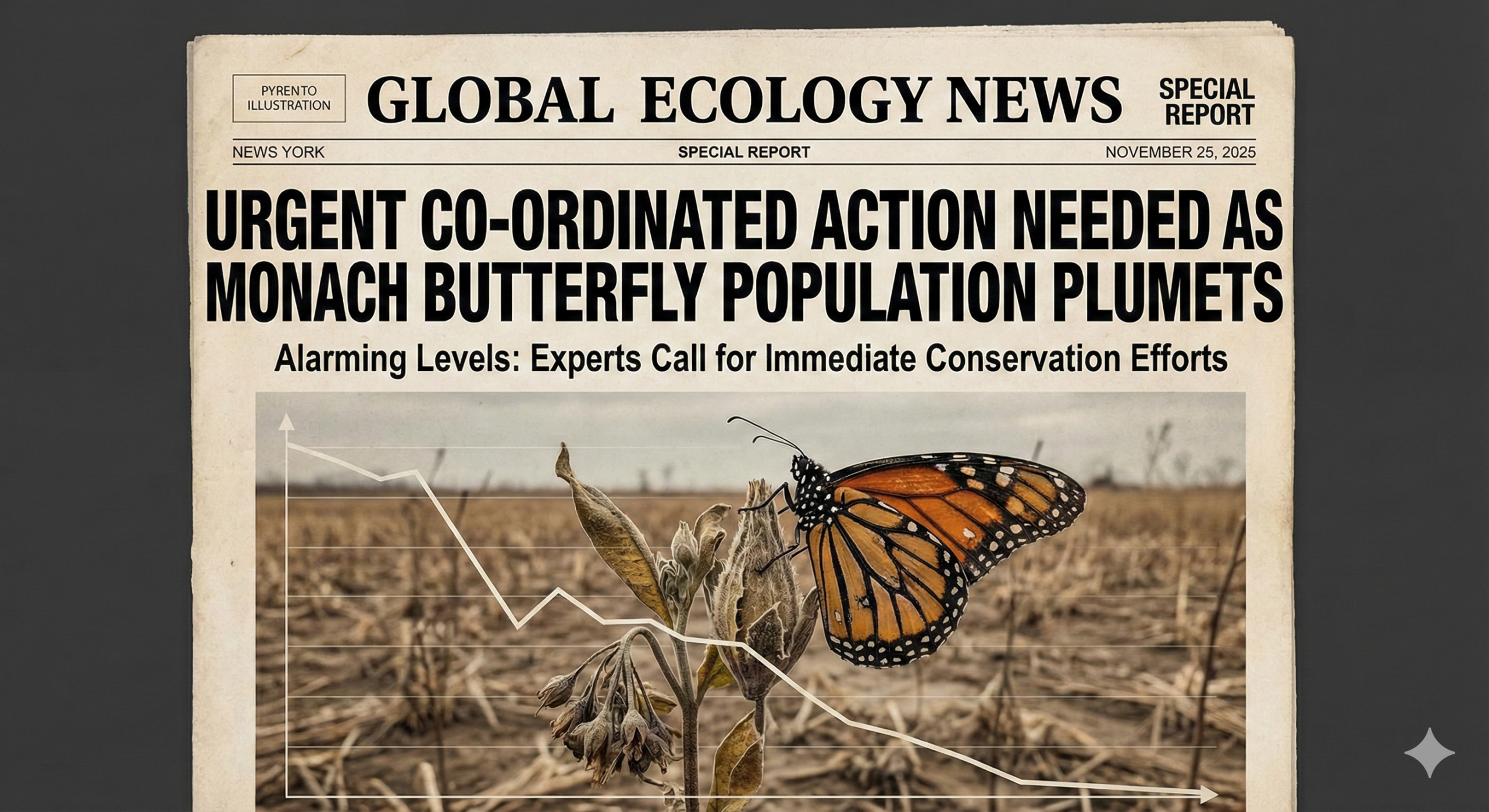
Monarch Butterfly Facing Unprecedented Decline
The monarch butterfly, one of North America’s most recognised and cherished species, is now confronting a steep and deeply concerning population crash. Researchers are warning that without immediate and co-ordinated action from Canada, the United States and Mexico, the iconic migratory insect could face extinction within the foreseeable future.
A recent study published in Current Biology reveals that the monarch population has fallen by nearly 80 per cent over the last two decades. Scientists say the most significant cause of this catastrophic drop is the widespread destruction of breeding habitats, particularly the disappearance of milkweed plants — the sole food source for monarch caterpillars.
This dramatic decline represents not only an ecological crisis but also a profound cultural and environmental loss for all three countries, where the monarch is woven into both natural heritage and public consciousness.
The Extraordinary Migration at Risk
Every year, millions of monarch butterflies embark on an extraordinary migration stretching thousands of kilometres. These fragile insects travel from southern Canada and the northern United States to the mountainous forests of central Mexico, where they overwinter before returning north in the spring.
Weighing less than a gram, monarchs rely on favourable weather patterns and suitable habitat along their route to survive this demanding journey. Their migration is one of the most remarkable natural phenomena on the planet — yet it is now increasingly threatened by shrinking ecosystems and environmental instability.
Researchers measure the monarch population by calculating the area of forest occupied during the winter season in Mexico. The ideal conservation target sits around 132 million butterflies. However, recent counts suggest fewer than 40 million remain, a stark contrast to the estimated 300 million recorded in the early 1990s.
Ryan Norris, a professor of integrative biology at the University of Guelph and co-author of the study, describes these figures as “alarmingly low.” He warned that the species is now dangerously vulnerable to any major environmental catastrophe, such as a severe storm or deforestation event in Mexico, which could devastate the entire eastern population.
Habitat Destruction and Loss of Milkweed
The Core Driver of Decline
The most well-supported explanation for the monarch’s decline is the massive loss of breeding habitat, especially in the U.S. Midwest. Milkweed plants, essential for monarch reproduction, have been disappearing at an unprecedented rate due to modern agricultural practices, urban development and herbicide use.
Scientists estimate that more than one billion milkweed stems have been lost across North America in just a few decades. Without these plants, monarchs cannot lay their eggs, and caterpillars cannot survive, effectively halting population regeneration.
Tyler Flockhart, the study’s lead author and a population ecologist based in Saskatoon, explains that the loss of milkweed is the single most critical factor driving the species’ decline. While monarch populations naturally fluctuate, such a severe and sustained drop indicates a systemic failure of the ecosystem.
Climate Change and Other Contributing Factors
Although habitat destruction stands as the primary threat, monarchs are also impacted by several compounding pressures:
Extreme Weather Events
Increasingly frequent droughts, heatwaves and storms — driven by climate change — disrupt breeding cycles and migration patterns, reducing survival rates.
Overwintering Habitat Loss
Deforestation in the highlands of central Mexico continues to erode the forests where monarchs shelter during winter, leaving them exposed to colder temperatures and predators.
Pesticide Usage
The widespread use of chemical pesticides not only kills monarch larvae directly but also eliminates native plants critical to their lifecycle.
These interconnected threats combine to place tremendous strain on a species already struggling to sustain viable numbers.
Endangered Status and Global Concern
The monarch butterfly is officially listed as an endangered species in both Canada and Mexico. In the United States, the U.S. Fish and Wildlife Service has proposed classifying the monarch as threatened, a move that could significantly strengthen protections and funding for conservation efforts.
Experts argue that if meaningful intervention does not occur soon, the monarch population could collapse to near-zero levels within a single generation.
Proposed $150 Million Recovery Plan
To counter the alarming trend, researchers recommend a major investment of $150 million over five years to restore monarch habitats. The proposal prioritises the large-scale replanting of milkweed along major migration corridors, particularly in the U.S. Midwest, where agricultural expansion has been most damaging.
Flockhart stresses that targeted habitat restoration is essential if population levels are to recover to sustainable numbers. The plan advocates a continent-wide strategy rather than isolated local efforts, emphasising that monarch conservation must cross political boundaries to succeed.
Trinational Strategy: A United Front for Survival
The study calls for a coordinated conservation strategy involving Canada, the U.S. and Mexico. Researchers argue that piecemeal approaches will not be enough to preserve a species whose lifecycle spans three countries.
Ryan Norris noted that while various programs already exist, current efforts may not achieve long-term stability. Only unified planning, meaningful policy reform and substantial funding can prevent irreversible collapse.
Government Initiatives and Progress
Environment and Climate Change Canada confirmed it has been actively working with provinces, territories and international partners to bolster monarch protection. Since 2017, the department has invested over $10 million in 79 conservation projects nationwide.
These initiatives have secured more than 4,300 hectares of protected monarch habitat and improved an additional 4,900 hectares through native planting and restoration programs. While these measures have generated positive momentum, experts agree they are insufficient without broader international alignment.
The Role of Communities and Individuals
Encouragingly, public awareness has increased significantly. More homeowners, farmers and conservation groups across North America are planting milkweed in gardens, parks and agricultural margins.
Norris believes grassroots involvement can make a critical difference. “Everybody can do a little bit, and it would make a big difference,” he said, urging citizens to contribute wherever possible.
Cultural Importance of the Monarch Butterfly
Beyond its ecological value, the monarch butterfly holds deep cultural meaning. In Mexico, monarch migration coincides with the Day of the Dead, symbolising the return of spirits. In Canada and the U.S., the monarch is a symbol of transformation, resilience and natural wonder.
The thought of losing such an emblematic species resonates deeply with conservationists, educators and nature lovers across the continent.
“If we lost them, millions would regret not acting when they had the chance,” Norris said, highlighting the emotional and historical significance of the species.
A Species That Defies Imagination
Monarch butterflies exhibit an astonishing life cycle. Spring migrants live for about a month, breeding as they move north. The late-summer generation enters a state known as reproductive diapause, allowing them to survive up to nine months and reach their Mexican wintering grounds.
Flockhart, who has studied monarchs for nearly two decades, remains captivated by their extraordinary journey. “It’s hard to believe that something so small can travel such immense distances to a place it has never been,” he said.
A Narrow Window for Action
Scientists warn that time is running out. Without aggressive intervention, monarch butterflies may disappear within our lifetime — a loss that would echo for generations to come.
Yet there is still hope. With sustained political commitment, scientific guidance and public participation, the monarch population can rebound. Conservation experts stress that decisive action taken today could ensure future generations witness the awe-inspiring migration that has long defined North America’s natural landscape.
Preserving a Living Symbol
The monarch butterfly is more than just an insect. It is a living symbol of endurance, transformation and ecological balance. Saving it requires urgency, unity and responsibility.
The message from scientists is clear: the time to act is now. The fate of the monarch rests in the collective hands of governments, communities and individuals alike — and with the right measures, this magnificent species can once again flourish across the continent.